
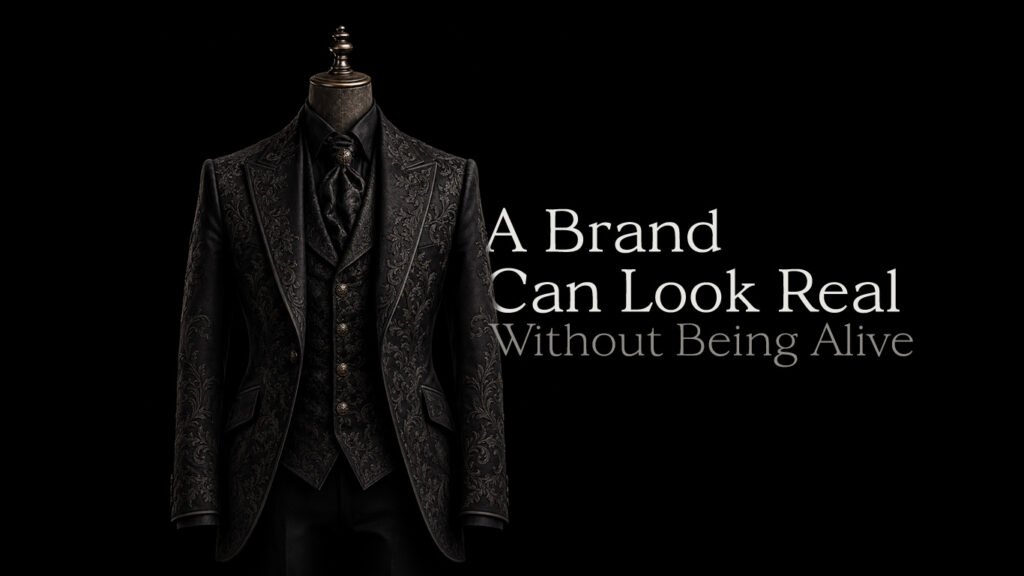
An exquisite dark tailored suit displayed on an empty antique mannequin, symbolizing a brand with a polished appearance but no character behind it.
Brand Worldbuilding

A Brand Can Look Real Without Being Alive

An impeccable appearance is a wonderful beginning. A rather unfortunate place to stop. A beautiful logo. An exquisite color palette. Typography selected with almost religious devotion. A brand book so elegantly designed that it deserves a place on the coffee table. Everything looks impeccable. And then someone asks a question that isn’t covered in the guidelines.Suddenly, no one knows what to do. An interesting problem, isn’t it? We spend considerable time defining how a brand should look, sound, and present itself. We describe its personality, select its archetypes, establish its values, and give it an identity that promises to be unmistakable. But what happens when that personality has to make a decision? When a customer complains. When an employee faces an unexpected situation. When an opportunity appears that is financially attractive but fundamentally incompatible with everything the brand claims to believe. Does the identity still exist beyond the presentation? . Looking the part is not the same as playing it Visual identity is an extraordinary instrument. It makes ideas tangible, creates recognition, and can communicate complex meanings before a single word is spoken. But there is a peculiar expectation that sometimes accompanies it: once an organization looks like the brand it wants to be, the rest will somehow follow. As though a beautifully tailored suit could provide the person wearing it with impeccable manners, remarkable intelligence, and excellent judgment. It certainly makes an impression. The rest, I’m afraid, requires a little more work. A brand’s character reveals itself through what it chooses, what it protects, how it treats people, and, perhaps most revealingly, what it refuses to do. These are not decorative details. They are the decisions that gradually make an identity believable. . The invisible work Building a brand world means investigating the logic that connects those decisions. It is not enough to declare that an organization is welcoming. We must understand what hospitality means in its particular universe. Nor is it enough to describe a brand as rebellious or disruptive. We must determine which conventions it challenges and which principles it would never be willing to compromise. Because rebellion without conviction is merely noise. And sophistication without substance is remarkably easy to imitate. The work extends into culture, relationships, language, rituals, services, experiences, and the countless small choices that rarely find their way into a brand presentation. This doesn’t make design less important. Quite the opposite. It gives design something worth expressing. Caradepau Produções | Rebellion is more interesting when it has a reason. . An interesting little experiment Imagine removing the logo, the colors, the typography, and every other visual signature from a brand. Could you still recognize it? In the way it welcomes someone, resolves a problem, makes a decision, or politely declines an opportunity that doesn’t belong in its world? If the answer is yes, something interesting has been built beneath the surface. If the answer is no, perhaps the identity is still waiting to become something more than an appearance. After all, looking alive and having a life of your own are two very different things. . Brand Strategist • Worldbuilder • Occasional troublemaker For more than two decades, she has been building brands, worlds, and making sense of things that refused to make sense. She works at the intersection of strategy, narrative, identity and experience. She firmly believes complexity is not the enemy. Unnecessary complexity is. When she is not building worlds, she is probably taking one apart to understand how it works. Founder of Arcane Studio and, apparently, responsible for most of what happens around here. The rest is classified.
Invisible Laws

Brand Guidelines Are Not a Constitution

Brand guidelines can define how a brand looks and speaks. But what happens when the rules run out? Discover what makes brand identity truly coherent. A brand can have hundreds of pages of guidelines and still have no idea what it stands for. It can specify the exact color of a button, the minimum distance around a logo, the preferred vocabulary, the tone of an email and the correct way to photograph a product. It can regulate almost every visible detail and still leave people wondering what to do when they encounter something the manual never anticipated. That is not necessarily a failure of the guidelines. It may simply mean that guidelines are being asked to do a job they were never designed to do. If we go back to the idea of worlds, the distinction becomes easier to see. A world has rules. But it also has something deeper: a logic that determines why those rules exist in the first place. A world needs more than instructions Imagine entering a fictional world with a very long instruction manual. It tells you what people wear, what buildings look like, which words they use and how they behave at dinner. Useful, perhaps. But you would still not necessarily understand the world. You would know its instructions without knowing its logic. That distinction matters because a coherent world has to deal with situations nobody planned for. The story introduces a new character. Someone breaks a tradition. A new technology appears. Two values come into conflict. A choice has to be made and there is no rule specifically covering it. What happens then? The answer cannot simply be, “check the manual.” Something deeper has to decide. This is where a constitution becomes interesting A constitution is not a list of everything a society might ever do. It establishes principles, structures and limits that allow decisions to be made even when the specific situation was never anticipated. That is a useful way to think about a brand. A brand identity is not only what the brand looks like. A brand strategy is not only what it wants to say. And brand consistency is not achieved by making every touchpoint identical. There has to be an underlying agreement about what this world considers true. What does it protect? What does it refuse? What does it reward? What kind of behavior belongs inside it? What would be considered a violation, even if nobody had written that particular situation down? These are not merely aesthetic questions. They determine decisions. And decisions are where a world reveals itself. The real test is what happens when the manual ends A brand guidelines document can tell a designer how to use a logo. It can tell a writer which words to avoid. It can tell a team how an image should look. But imagine something outside the document. A new product category. A completely different market. A crisis nobody anticipated. A customer request that does not fit any existing process. A new technology that changes the experience entirely. Suddenly, the question is no longer, “What does the guideline say?” The question becomes, “What would this brand do?” That is a very different question. And the answer reveals far more about the brand than another page of specifications ever could. The difference between a brand that looks coherent and one that is coherent This is also why brand experience can expose problems that brand identity alone cannot solve. A visual identity may be beautiful. The language may be consistent. The strategy may be perfectly articulated. Yet the moment someone interacts with the company, the logic disappears. The service behaves differently from the communication. The product contradicts the promise. The internal culture rewards behavior that the external brand would never tolerate. Everything looks aligned until people have to make decisions. Then the cracks appear. A coherent brand does not need every decision to look the same. It needs different decisions to emerge from the same underlying logic. That is a much stronger form of consistency. So perhaps the question is not whether you have brand guidelines Perhaps the more interesting question is whether your brand could survive a situation they never anticipated. Could someone who has never met the founder make a difficult decision and still make one that feels unmistakably right for the brand? Could a new team member understand not only what to do, but why? Could the brand enter a completely unfamiliar context without losing itself? If the answer is yes, there is probably something underneath the guidelines doing the real work. Something closer to a constitution. Not a document that tells the world what to do. A system that tells the world what must remain true. And perhaps that is the difference between a brand with rules and a brand with a world. . You didn’t see this here Brand Strategist • Worldbuilder • Occasional troublemaker For more than two decades, she has been building brands, worlds, and making sense of things that refused to make sense. She works at the intersection of strategy, narrative, identity and experience. She firmly believes complexity is not the enemy. Unnecessary complexity is. When she is not building worlds, she is probably taking one apart to understand how it works. Founder of Arcane Studio and, apparently, responsible for most of what happens around here. The rest is classified.

Rolar para cima